Digital Insulation Resistance Meter Explained: A UK Buyer's Guide
Key Takeaways
- A digital insulation resistance meter measures how well cable and equipment insulation resists leakage current, helping electricians verify safety and compliance with BS 7671.
- Digital models are generally preferred in the UK because they provide clearer readings, better repeatability, automatic discharge functions, and often data logging.
- When choosing a meter, focus on suitable test voltages, CAT safety ratings, accuracy, and ease of use in domestic and commercial settings.
- For EICRs, fault-finding, and installation verification, a reliable digital tester can improve both speed and confidence on site.
TL;DR
A digital insulation resistance meter is a test instrument used to check whether electrical wiring, cables, and equipment insulation are safe and intact by applying a DC test voltage and measuring resistance in megohms. In practice, UK electricians use it for EICRs, new installations, and fault diagnosis because digital models give clear readings, support BS 7671 testing workflows, and usually offer safer, faster operation than older analogue units.
A digital insulation resistance meter is used to test the condition of electrical insulation by applying a controlled DC voltage and measuring resistance between conductors or to earth. In the UK, it is a standard tool for confirming wiring safety during installation work, periodic inspection, fault-finding, and EICRs under BS 7671.
Ensuring electrical safety across UK properties requires precise diagnostic equipment. Whether you are signing off a new domestic consumer unit or carrying out routine maintenance in a commercial premises, verifying that insulation has not degraded is an essential step. According to UK guidance and common industry practice under BS 7671, insulation resistance testing helps identify leakage paths that could otherwise lead to electric shock risk, nuisance tripping, damaged equipment, or fire hazards.
At InsulResis, based on our testing of compact digital testers for everyday site use, professionals consistently favour digital models because they remove much of the guesswork associated with needle-based displays. As a result, readings are easier to interpret quickly in cupboards, lofts, risers, plant rooms, and other awkward working environments.
What is a digital insulation resistance meter?
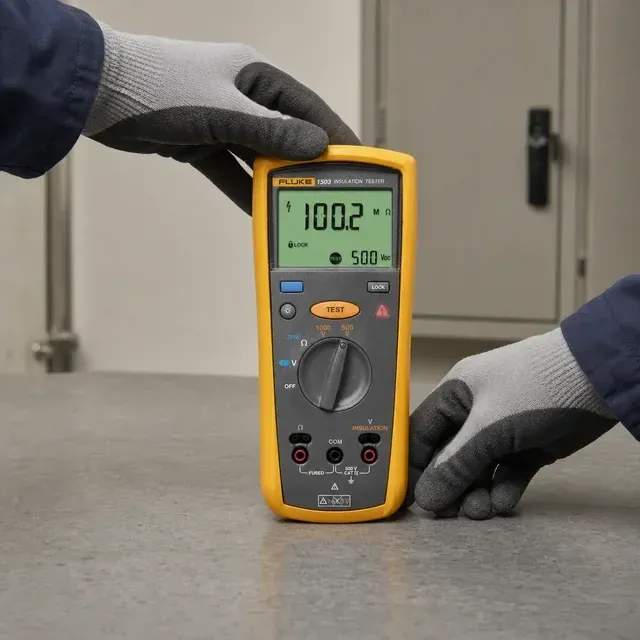
A digital insulation resistance meter, often called a megohmmeter or “megger”-type tester in general trade language, checks the integrity of cable and equipment insulation by applying a higher-than-normal DC test voltage. It then measures how much the insulation resists current flow. The higher the resistance value in megohms (MΩ), the better the insulation condition is likely to be.
In simple terms, the meter helps you confirm that current is not leaking where it should not. Therefore, it plays an important role in verifying safety before energising circuits or when investigating suspected faults.
Most digital units provide selectable test voltages such as 250V, 500V, and 1000V. These ranges make the instrument suitable for different circuit types and installation conditions. For example, many standard low-voltage installation tests in the UK are carried out at 500V DC where appropriate. For a broader overview of where this instrument fits into an electrician’s toolkit, see our ultimate guide to electrician insulation meters in the UK.
How does a digital insulation resistance meter work?
A digital insulation resistance meter works by generating a stable DC test voltage and applying it across the insulation being tested. It then measures the tiny amount of leakage current that passes through that insulation and converts the result into a resistance reading.
The process is straightforward:
- The circuit or item under test must first be isolated safely.
- The tester applies the selected DC voltage between two points such as phase-to-earth or phase-to-neutral.
- The instrument calculates insulation resistance from the resulting current flow.
- The final value appears digitally on screen for quick interpretation and recording.
Because digital instruments display exact figures rather than estimated needle positions, they are especially useful when producing reports or comparing results over time. In addition, many models include automatic discharge after testing so residual charge is removed more safely from capacitive circuits.
Why use a digital insulation resistance meter instead of an analogue tester?
Many UK electricians prefer digital testers because they are clearer to read, easier to document from, and often faster to use consistently across multiple circuits. By contrast, analogue meters can still be effective but usually require more interpretation from the user.
Are digital readings easier to interpret?
Yes. A backlit LCD gives an exact number rather than relying on a moving needle against a printed scale. Consequently, there is less ambiguity when working in poor light or under time pressure during inspections.
Do digital meters improve safety?
In many cases they do. Modern units often include automatic discharge functions after testing as well as live-circuit warnings. These features help reduce risk to both the operator and connected equipment when used correctly alongside safe isolation procedures.
Are digital meters better for record-keeping?
Generally yes. Some models allow data hold or data logging functions so readings can be transferred more accurately into certificates or maintenance records. This is particularly helpful during commercial inspections where documentation standards are stricter.
What should you look for in a digital insulation resistance meter?
Selecting the right digital insulation resistance meter depends on your typical jobs. However, several features matter in almost every UK setting.
What test voltage ranges do you need?
A versatile tester should offer appropriate voltage options such as 250V, 500V and 1000V. For instance:
- 250V: often suitable for sensitive circuits or electronics-related applications where lower stress is required
- 500V: commonly used for many low-voltage fixed wiring tests
- 1000V: useful for heavier-duty or specialist applications where standards and equipment ratings permit
Therefore, choosing multiple test ranges gives you flexibility without risking unnecessary damage to connected components.
Why do CAT III and CAT IV ratings matter?
Measurement category ratings indicate how well an instrument can withstand transient overvoltages in different environments. For work near distribution boards or incoming supplies, these ratings are especially important. According to standard industry practice in the UK:
- CAT III: typically relevant for distribution-level fixed installation circuits
- CAT IV: typically relevant closer to source supply points and outdoor service entrances
If your work regularly involves inspection at boards or incoming positions, paying attention to CAT ratings is essential when choosing any tester intended for professional use. For related buying considerations, see our guide to choosing a suitable commercial electrical tester.
How important are size and ergonomics?
Very important. Electricians often test circuits in cramped spaces such as understairs cupboards, service risers or above suspended ceilings. A compact unit with clear controls can speed up repetitive testing while reducing hand fatigue over long inspection days.
Based on our testing at InsulResis, practical features like firm grip surfaces, robust lead storage and large-screen visibility make more difference on site than spec sheets alone might suggest.
Should you choose data logging?
If you complete frequent EICRs or commercial maintenance reports, data logging can be valuable. It helps reduce transcription errors and supports trend monitoring over time. However,h if your work is mainly occasional domestic testing,h simple clear readout accuracy may be more important than advanced memory functions.<\/pp> 内容
Ready to upgrade your toolkit with {brand_name}?
View Trade Prices — £377.00